

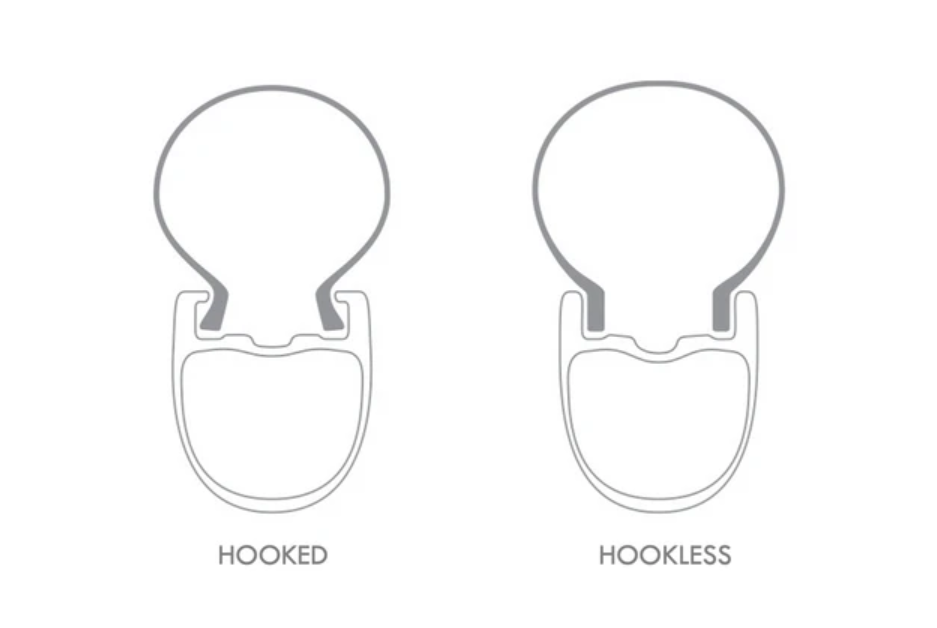
I’ll admit it: I love a good bike tech debate. There’s something about cycling’s endless appetite for “innovation” that keeps the workshop chats interesting, and nothing has stirred the pot quite like the rise of hookless rims on road bikes. If you’ve been anywhere near a group ride or a bike shop counter in the past couple of years, you’ve probably heard the arguments about whether hookless is the future, or just another marketing ploy.
So….What are Hookless Rims?
Hookless rims are exactly what they sound like: rims without the little bead rollover or “hooks” at the very outer edge that have traditionally kept your clincher tyre in place. Why? Fewer manufacturing steps, maybe some weight savings, and—if you believe the hype—aerodynamic gains. But as with all things in cycling, it’s not that simple.
The Case Against: Josh Poertner’s Take
Josh Poertner, who knows a thing or two about wheels (former Zipp tech director, now at Silca), is now on record: “Hookless rims are a scam.” His words, not mine. According to Poertner, the only real benefit is for the manufacturers—they’re easier and cheaper to make. For the rider? He reckons there’s “zero performance advantage,” and, more worryingly, a real safety risk if you stray outside the narrow band of approved tyre sizes and pressures.
Poertner has also pointed out other issues with tyre choice vs hookless aero claims. His ‘Rule of 105’ states that a rim needs to be 105% the width of the tyre for unbroken and efficient airflow. Hookless rims tend to make tyres fit ‘wider’ than their size designation would suggest, whilst simultaneously forbidding the use of anything smaller than a 28mm tyre. See the problem here? Claiming better aero, but forcing riders onto a 28mm front tyre, which is made wider by the hookless rim, which then STILL needs to be wider than the tyre…..
The entire system has to have more frontal area just so tyre blow-off risk is reduced. In engineering terms……we’re robbing Peter to pay Paul.
He’s not alone. DT Swiss, for example, has stuck to hooked rims, arguing it gives riders a safer, wider choice of tyres. And while some brands claim hookless is more aero, Poertner flatly disagrees. He says he’s never seen a real-world wind tunnel test where hookless rims actually outperformed their hooked counterparts.
The Real-World Dilemma
Let’s say you’ve just splashed out on a set of Hunt SUB50 Limitless wheels (hookless, of course). You want to run your favourite 25c tyre up front and a 28c at the rear, chasing that elusive “rule of 105” for optimal aero. But here’s the catch: the ETRTO (that’s the European Tyre and Rim Technical Organisation) says you can’t go above 72.5psi on hookless rims, and Hunt themselves say you shouldn’t run anything narrower than a 28c tyre. So if you’re hoping to pump your 25c up to 80psi and go full aero, you’re out of luck—and potentially in danger of a blow-off.
Poertner’s seen tyres rated for hookless blow off as low as 78psi in the lab. Not exactly confidence-inspiring for a piece of kit that’s supposed to keep you rubber-side down.
(Not picking on Hunt here, they haven’t done anything wrong or made any dubious claims)
Is There a Middle Ground?
Hunt, for their part, push back on some of Poertner’s claims. Their SUB50 Limitless front rim is a whopping 34.2mm wide externally, which, they argue, makes it plenty aero with a 28 or even 30mm tyre. They also point out that most of their customers are already running 28s or wider, and that tyre choice is about more than just aerodynamics—grip, comfort, and rolling resistance matter too.
There’s also been a response from tyre makers. Vittoria, for example, started making 29c tyres specifically to fit the minimum size requirements for hookless rims, and Continental has their own “wide rim optimised” options. The industry is adapting, but it feels a bit like a moving target.
Safety First (Or At Least, Safety Somewhere)
The safety debate isn’t going away. After a high-profile tyre blow-off and crash at the 2024 UAE Tour, the UCI stepped in, reminding teams to stick to the latest ISO standards and promising a closer look at the rules. Some pros and engineers are openly skeptical that hookless can ever be as safe as the old hooked design, especially at the pressures and sizes roadies love. Let’s not turn this into an article about the UCI….
So, Where Do I Stand?
Look, I get the appeal. But I’ve seen enough trends come and go to know not all that glimmers is gold. If you’re running hookless, make sure you’re using the right tyres, at the right pressures, and don’t try to outsmart the safety recommendations. And if you’re happy on hooked rims? Good. Stay there.
At the end of the day, bikes are supposed to be fun, not stressful. If you’re losing sleep over bead hooks and ISO standards, maybe it’s time to just go for a ride and leave the tech wars for another day.
Got a strong opinion on hookless? Drop by the shop and let’s chat.